Every day, Aeroporti di Roma strives to guarantee its passengers a unique travel experience, overturning the paradigm that sees the airport as a mere point of arrival or departure. Today, the ‘Leonardo da Vinci’ airport stands as a 'diffuse museum' within which all forms of the huge Italian cultural and artistic heritage are enhanced, acting as a stage for the promotion of talent and as a showcase for the cultural and artistic events taking place in the capital.
Ferro bifrontale arancione
Terminal 3 Boarding Area E
Pietro Consagra (1920–2005) was one of the leading figures in twentieth-century Italian abstract sculpture. A founding member of the Forma 1 Group, he developed an artistic practice that challenged the traditional conception of sculpture as monumental volume, favouring essential surfaces, compositional rhythm and a more direct relationship with the viewer.
Ferro Bifrontale Arancione (Orange Bifrontal Iron) belongs to the Bifrontali series, produced between 1968 and 2004. In these works, the distinction between front and back disappears: both sides are equally important and are intended to be viewed from multiple perspectives. The sculpture appears to change as the viewer moves around it, without privileging a single viewpoint.
First presented in 1978 at Spoleto Festival USA in Charleston, the work is distinguished by its intense orange colour, which reflects the visual sensibility of the 1970s and introduces an unusual chromatic note into the artist's oeuvre. Iron, a material usually associated with industrial production, also acquires an unexpected quality: changing light continually alters its appearance, making the surface appear alive and ever-changing.
Located in the Terminal 3 Boarding Area E at Rome's Leonardo da Vinci–Fiumicino Airport, the sculpture quietly accompanies travellers through the terminal. Its bifrontal structure invites viewers to consider the work from different angles, suggesting that every journey can be understood from more than one perspective. Like the act of travelling itself, the sculpture invites us to change our point of view.
MURO BIANCO (1975)
Terminal 1 Departures
Pietro Consagra (1920–2005) was one of the leading figures of twentieth-century abstract sculpture, renowned for revolutionizing the concept of three-dimensionality. A founder of Gruppo Forma 1, an important artistic collective established in Rome in 1947 that promoted a new idea of abstraction, the Sicilian artist broke away from the tradition of sculpture “in the round” to develop what he called “frontal sculpture.”
His works, often thin, flat, and two-dimensional, seek a direct, immediate, and accessible dialogue with the viewer, eliminating the encumbrance of volume in order to transform sculpture into a visual form that interacts with the surrounding space.
Through the use of materials such as iron, bronze, marble, and wood, the artist developed a visual language based on overlapping elements and linear rhythms, aimed at freeing art from the weight of classical monumentality.
Located within Terminal 1 Departures at Rome Fiumicino Airport, this work belongs to the Bifrontali series, sculptures created between 1968 and 2004, and is composed of four structures with sinuous, arabesque-like profiles: one has a trapezoidal shape with wavy upper and lower edges, while the others consist of ornamental forms defined by straight and curved incised lines carved both along the edges and across the surfaces.
The choice of iron, already present in Consagra’s work since the late 1940s and closely linked to the research of Gruppo Forma 1, is not merely technical. Commonly associated with industrial production, the material is reinterpreted and transformed through form and color. Consagra reshapes its perception in order to make sculpture more accessible and engaging, without sacrificing the complexity of artistic research.
The conservation work on the sculpture was carried out as part of the educational activities of the Master’s Degree Program in Conservation and Restoration of Cultural Heritage at the University of Tuscia – DIBAF, in Viterbo, in coordination with the restoration specialists of the National Gallery of Modern and Contemporary Art in Rome.
This work belongs to the Bifrontali series, sculptures created between 1968 and 2004, and is composed of four structures with sinuous, arabesque-like profiles: one has a trapezoidal shape with wavy upper and lower edges, while the others consist of ornamental forms defined by straight and curved incised lines carved both along the edges and across the surfaces.
Daring peace together for a future without hate
Inspired by the anthropologist James George Frazer’s The Golden Bough, a study devoted to myth, archetype, and symbolic stratification, the artwork presents itself as an image of passage, of transformation and cyclical renewal. The branch thus becomes a threshold sign, an emblem of a crossing to be undertaken.
The Golden Bough, understood as a symbol of knowledge and access to a deeper dimension of human experience, takes on an auspicious quality: a promise of return and regeneration. It is not what is cut that matters, but what continues to sprout; not an object, but a condition. A dynamic threshold that both separates and connects, holding in tension two states, two temporalities, two dimensions of human experience.
Giosetta Fioroni’s artwork celebrates the continuity of life, the capacity of art to preserve and renew symbols, and the cyclical nature of existence — an act of trust and hope. The Golden Bough is itself both key and sign of passage; as in myth, its value lies not in what it is, but in what it makes possible: the crossing. It reminds us that a threshold is never neutral; it demands attentiveness, awareness, and a willingness to change.
In Fioroni’s vision, the crossing is intimate and silent, entrusted to an image that invites pause. The threshold does not lead elsewhere in any definitive sense, but opens instead onto an inner possibility, a shift of gaze and consciousness.
At the base we see the “little house,” an object only seemingly simple. In reality, it is one of the artist’s most layered symbols, operating on multiple levels: it is refuge, a primary and archetypal space tied to childhood, emotional memory, and the idea of protection. It often retains a certain fragility: it is not the house of power or monumentality, but the inner house one carries within.
At the same time, however, the house is itself a threshold: the point of transition between outside and inside, between the world and intimacy, between exposure and withdrawal. In Fioroni’s artwork it becomes a mental space, permeable and inhabited by memory. It is also identity: the place from which one looks out at the world and to which one returns. In a poetics shaped by time, history, and collective memory, the little house suggests that every crossing, every threshold, requires a place from which to begin.
Placed within a site dedicated to travel, Rome Fiumicino Leonardo da Vinci airport, the artwork invites us to recognize in physical movement a symbolic journey as well: every departure and every return entail transformation. It asks us to acknowledge an additional dimension to spaces of transit: not merely infrastructure, but symbolic sites of human passage par excellence. The airport thus becomes a modern gateway, a contemporary “sacred forest” where millions of destinies intersect, brush past one another, separate, and meet again. In this context, Giosetta Fioroni’s branch appears as a quiet sign of orientation, a promise of meaning within ceaseless movement.
“Curiosity is the very essence of culture” Goffredo PARISE
New - Giosetta Fioroni the golden bough
Inspired by the anthropologist James George Frazer’s The Golden Bough, a study devoted to myth, archetype, and symbolic stratification, the artwork presents itself as an image of passage, of transformation and cyclical renewal. The branch thus becomes a threshold sign, an emblem of a crossing to be undertaken.
The Golden Bough, understood as a symbol of knowledge and access to a deeper dimension of human experience, takes on an auspicious quality: a promise of return and regeneration. It is not what is cut that matters, but what continues to sprout; not an object, but a condition. A dynamic threshold that both separates and connects, holding in tension two states, two temporalities, two dimensions of human experience.
Giosetta Fioroni’s artwork celebrates the continuity of life, the capacity of art to preserve and renew symbols, and the cyclical nature of existence — an act of trust and hope. The Golden Bough is itself both key and sign of passage; as in myth, its value lies not in what it is, but in what it makes possible: the crossing. It reminds us that a threshold is never neutral; it demands attentiveness, awareness, and a willingness to change.
In Fioroni’s vision, the crossing is intimate and silent, entrusted to an image that invites pause. The threshold does not lead elsewhere in any definitive sense, but opens instead onto an inner possibility, a shift of gaze and consciousness.
At the base we see the “little house,” an object only seemingly simple. In reality, it is one of the artist’s most layered symbols, operating on multiple levels: it is refuge, a primary and archetypal space tied to childhood, emotional memory, and the idea of protection. It often retains a certain fragility: it is not the house of power or monumentality, but the inner house one carries within.
At the same time, however, the house is itself a threshold: the point of transition between outside and inside, between the world and intimacy, between exposure and withdrawal. In Fioroni’s artwork it becomes a mental space, permeable and inhabited by memory. It is also identity: the place from which one looks out at the world and to which one returns. In a poetics shaped by time, history, and collective memory, the little house suggests that every crossing, every threshold, requires a place from which to begin.
Placed within a site dedicated to travel, Rome Fiumicino Leonardo da Vinci airport, the artwork invites us to recognize in physical movement a symbolic journey as well: every departure and every return entail transformation. It asks us to acknowledge an additional dimension to spaces of transit: not merely infrastructure, but symbolic sites of human passage par excellence. The airport thus becomes a modern gateway, a contemporary “sacred forest” where millions of destinies intersect, brush past one another, separate, and meet again. In this context, Giosetta Fioroni’s branch appears as a quiet sign of orientation, a promise of meaning within ceaseless movement.
“Curiosity is the very essence of culture” Goffredo PARISE
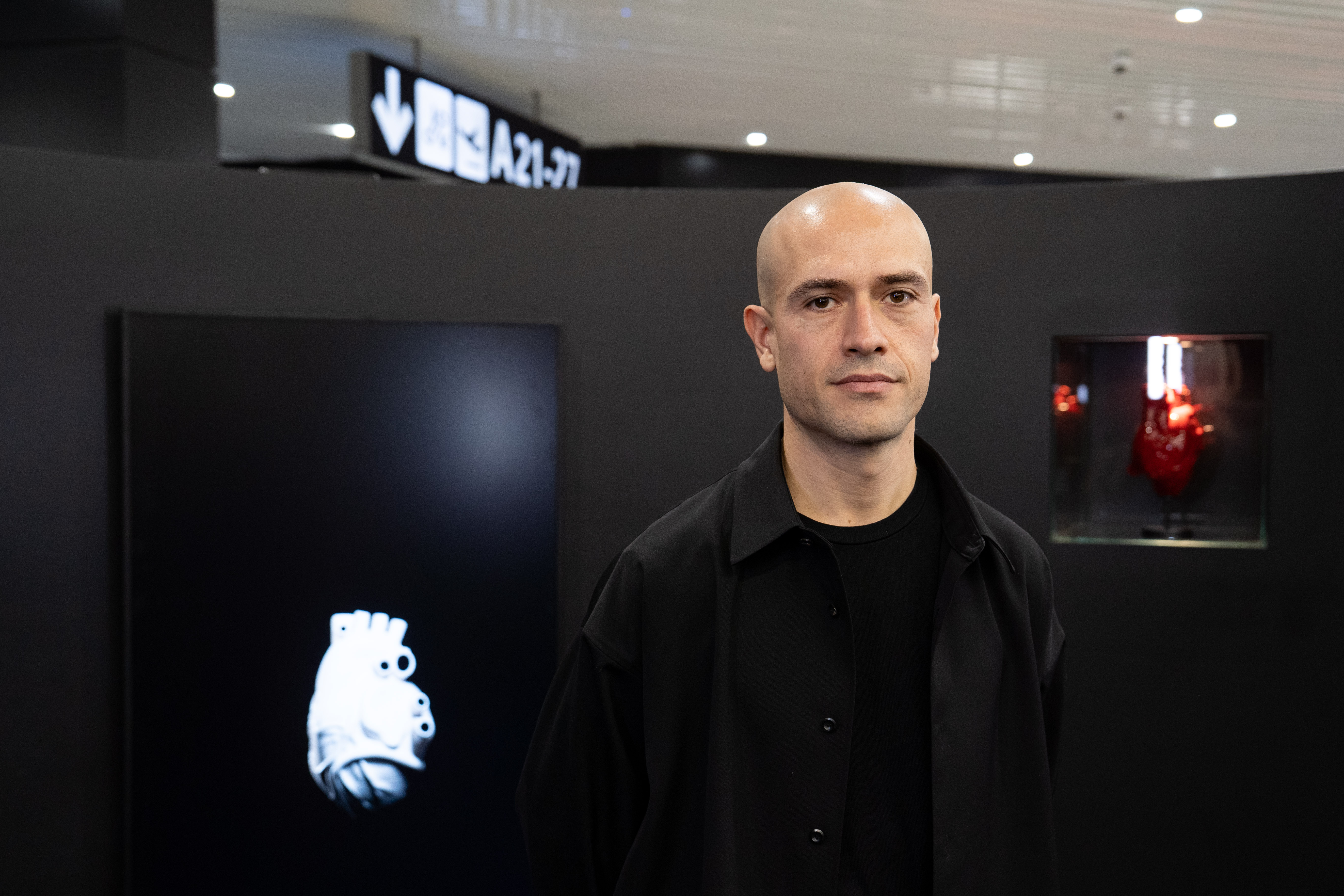
JAGO – Apparato Circolatorio
Inside Terminal 1 of Rome Fiumicino Airport, “Apparato Circolatorio” takes shape as an immersive installation by Jago, one of the most internationally recognised voices in contemporary Italian sculpture. The work welcomes passengers into a space of quiet reflection, where waiting time becomes an opportunity for awareness and connection.
The installation consists of six red ceramic hearts, drawn from an original work created by Jago in 2017. Arranged in a circular form, a shape with no beginning and no end, the hearts are accompanied by a video projection that reproduces their rhythmic pulsation, making visible what usually remains unseen: the beat of life itself. Each heart embodies a universal value, equality, empathy, memory, hospitality, hope and courage, transcending languages, cultures and borders.
Set within a place that symbolises global mobility, «Apparato Circolatorio” invites travellers to recognise themselves as part of a shared humanity. The steady rhythm of the beating hearts becomes a common language, capable of connecting people from different origins, destinations and personal histories. The work does not demand prolonged attention, but offers, even for just a moment, a profound space of collective and intimate connection.
The installation is part of Aeroporti di Roma’s broader vision to transform Fiumicino Airport into an open cultural platform, where contemporary art engages with the journey and enriches the travel experience. In this context, Jago’s work goes beyond aesthetic value, becoming a meaningful statement: even in places defined by speed and transit, there is room for reflection, human presence and shared values.
Visible to all passengers, Apparato Circolatorio stands as a quiet yet powerful invitation to reconnect with what unites us most deeply, the shared rhythm of being human.
“Davide Bramante – Art as a Journey"
In celebration of the Jubilee, Rome’s Fiumicino and Ciampino airports welcome the art of Davide Bramante, internationally renowned photographer and visual artist, with an exhibition project dedicated entirely to Rome, the eternal city and symbol of connection between stories and destinations.
Born in Syracuse in 1970, Bramante studied set design in Turin and Cosenza, and has lived in Rome, London, Milan and New York, among other cities. Throughout his career, he has exhibited in prestigious museums and foundations around the world – from the MoMA in New York to the PAN in Naples, the Korea Foundation in Seoul and the GAM in Turin – and won, among others, the Canova Prize in New York in 2018. His works are held in important public and private collections, including Unicredit, Lavazza, GAM Turin and the Castello Sforzesco in Vigevano.
A layered visual language
Bramante is known for his photographic technique of multiple exposures on film – four to nine shots superimposed on a single frame – with which he depicts urban visions of cities such as New York, Beijing, Paris, Cairo, St Petersburg, Shanghai and, of course, Rome. The result is dense and fascinating images in which places, emotions and memories merge into a dimension suspended between dream and reality.
‘My way of photographing is like remembering, thinking, dreaming. Everything happens by temporal and spatial superimpositions, creating visual short circuits that represent a life in perpetual suspension.’
– David Bramante
The works on display
Amid the architectures of Fiumicino’s Terminal and, at Ciampino, within the spaces of General Aviation, Bramante’s works accompany travellers on a visual journey suspended between lightness and memory, between lived cities and imagined ones.
The Aerea series consists of seven photographic installations suspended about three metres from the ceiling, resembling light floating curtains. Designed to move as passengers pass by, they create a direct and poetic interaction with the public, evoking the continuous transit between places and cultures. The title not only recalls the lightness of flight, but also plays on the assonance with aeroporto (airport), suggesting a deep connection between image, space and meaning.
Alongside these installations, a selection of large photographic works dedicated to Rome – created from 2004 to the present day – offers a powerful and contemporary interpretation of the city. They are accompanied to great effect by the face of another metropolis that Bramante loves: New York, a constant reference in his travels and poetry.
Together, the works construct a visual tale of departures, returns and new starts, taking the spectator between past and present, between what we leave behind and what we are looking for.
Davide Bramante is represented in Italy by Anna Marra – Rome and Studio la Città – Verona.
“Grande folla n.1” by Giò Pomodoro, one of the masterpieces of the GNAMC: from May 2025 to May 2026
From 8 May 2025, Rome's Fiumicino Airport will further enrich its dialogue with contemporary art by hosting the monumental sculpture "Grande Folla n.1" by Giò Pomodoro in Terminal 1. Pomodoro is one of the most recognised masters of 20th-century Italian sculptural abstraction.
The work, on loan from the National Gallery of Modern and Contemporary Art (GNAMC) in Rome, has been restored thanks to the support of Aeroporti di Roma and will be on display for a year, offering millions of travellers an unexpected encounter with beauty and contemplation.
Born in Orciano di Pesaro in 1930, Giò Pomodoro distinguished himself from the 1950s onwards with an artistic exploration focused on the balance between form and energy. After moving to Milan, he developed a distinctive style that combined geometric abstraction with the expressive power of materials. His body of work spans sculpture, engraving, and set design, and is present in collections and public spaces in Italy and abroad. Pomodoro has always viewed art as a living element, one that integrates into the urban landscape and the everyday life of people.
A work that comes to life among the faces in transit
Created in 1964, the sculpture stands out for its gleaming bronze, shaped into forms that evoke the flow of people in motion. Its voids and solids chase each other, creating shifting reflections in which the faces, emotions, and stories of the travellers who pass by are mirrored.
A work designed to interact with its space, to transform continuously, much like in airport terminals: places where time flows, and identities merge, even if only for a moment.
To enhance the immersive experience of passengers, Terminal 1 also features the digital installations "Pillars of Art", showcasing images of works from the collection of the National Gallery. This selection is intended to interact conceptually with Pomodoro's sculpture, offering a glimpse of the main movements and artistic currents that have shaped the history of modern and contemporary Italian art.
A symbol of Italy looking to the future
"Grande Folla n.1" is not only a testament to the expressive power of Giò Pomodoro but also serves as an emblem of an Italian art in constant motion, capable of evolving, experimenting, and engaging with the present.
Its presence in the heart of Terminal 1 represents a strong, immersive, and contemporary artistic gesture, designed to welcome travellers with an invitation to discover a vibrant Italy, one that is rooted in history but continues to generate innovation and creativity.
This message also reflects the identity of the National Gallery of Modern and Contemporary Art, the custodian of an extraordinary heritage in terms of both scale and variety: over 20,000 works, including paintings, sculptures, installations, photographs, design objects, and videos, the result of more than a century of acquisitions and donations from artists and patrons.
The Last Supper: “The Living Tableau” by Armondo Linus Acosta - from April 2025 to November 2025
On the occasion of the Jubilee Year, Leonardo da Vinci Fiumicino Airport presents The Last Supper: The Living Tableau, a video installation inspired by Leonardo da Vinci's masterpiece, “The Last Supper”.
Directed by American award-winning filmmaker Armondo Linus Acosta, this nine-minute cinematic work was created through the collaboration of three renowned names in Italian cinema, all Oscar winners: cinematographer Vittorio Storaro, set designer Dante Ferretti, and set decorator Francesca Lo Schiavo.
First presented in 2019 to mark the 500th anniversary of Leonardo’s death, the installation has already been showcased in numerous international cultural venues. Displayed within Terminal 1 of Fiumicino airport, this exhibition is part of a broader initiative aimed at bringing art into spaces of transit and connection, making it accessible to a wide and diverse audience.
The narrative begins with a timeless landscape, accompanied by Rossini’s Stabat Mater. Gradually, the scene unfolds: the room, the table, the twelve apostles, and finally, Jesus, who performs the gesture of blessing and announces the betrayal. The staging is meticulously crafted, with perspective, lighting, costumes, and movements all designed to capture the visual and symbolic essence of the original painting.
A distinctive element of the project is the casting choice: instead of professional actors, members of the production team were selected for their resemblance to the characters in the painting. The director himself portrays the apostle Thaddeus. The costumes, tailor-made from plaster molds, enabled the creation of static poses faithful to Leonardo’s iconic depiction.
The result is a powerful work that, despite its stillness, conveys profound emotions through glances, lighting, and silence.
This initiative offers a unique cultural experience within the airport, a space frequented every day by thousands of people. In a context defined by travels, waiting and movements, The Living Tableau offers a moment of pause and reflection, accessible free of charge to passengers and visitors.
Etruscans for Eternity
On Monday, December 16, 2024, Fiumicino Airport unveiled an exhibition featuring three remarkable Etruscan sculptures from the permanent collection of the National Etruscan Museum of Villa Giulia.
The exhibition, titled "Etruscans for Eternity," was unveiled in the Terminal 1 arrivals hall, offering thousands of daily passengers the opportunity to admire these extraordinary masterpieces. The inauguration was graced by the presence of Marco Troncone, CEO of Aeroporti di Roma; Luana Toniolo, Director of the National Etruscan Museum of Villa Giulia; Francesco Rocca, President of the Lazio Region; and Roberto Vannata, from MIC’s General Directorate for Museums.
Through a collaboration between Aeroporti di Roma, the Directorate-General for Museums and the National Etruscan Museum of Villa Giulia, these remarkable artefacts of Etruscan culture have been "brought to life" at the airport. Carefully chosen by the museum's curators, the sculptures offer visitors a captivating window into the rich heritage of this ancient civilisation, encouraging them to explore the museum further.
The exhibition showcases two travertine funerary urns from Perugia and a sarcophagus lid from Tuscania. These exquisite pieces portray idealised figures of Laris Afle, Arnth Acsi, and Larth Cales—believed to be aristocratic men from the 2nd century B.C. Each is depicted reclining at a symposium, a cornerstone of Etruscan social life, where attendees gathered to drink, chat and enjoy music.
The bases of the urns are intricately decorated with mythological scenes, including The Seven Against Thebes, where Oedipus mourns his sons, and the Sacrifice of Iphigenia by her father Agamemnon. These timeless Greek myths, rich with universal themes that continue to resonate, embody the core values of Etruscan society. Through their exploration of real and symbolic journeys, the sculptures encourage contemplation of the past and future, reality and imagination, as well as lived experiences and aspirations.
This collaboration received strong backing from Luana Toniolo, Director of the National Etruscan Museum of Villa Giulia, who remarked: "Our aim is to extend the museum’s reach beyond its walls, bringing it into high-traffic spaces like airports to create 'oases' of beauty that spark reflection on the shared cultural heritage we all possess. Through this partnership with Aeroporti di Roma, we aim to expand awareness and foster greater appreciation for our cultural treasures, even among travellers in transit."
Aeroporti di Roma has consistently embraced a strategy of promoting and celebrating Italy's rich cultural heritage through partnerships with renowned cultural institutions and museums. These collaborations have brought archaeological treasures, artworks spanning diverse eras, and contemporary installations to Leonardo da Vinci Airport. The initiative seeks to redefine transit spaces as vibrant showcases for art and culture in all their forms.
"With the unveiling of these three remarkable sculptures, we are enhancing the artistic and cultural offerings at our airport, marking the beginning of a strategic partnership with the National Etruscan Museum of Villa Giulia," said Marco Troncone, CEO of Aeroporti di Roma. "Today, we offer our passengers and the entire airport community the opportunity to engage with the historical legacy of the Etruscan civilisation's historical significance, which also flourished in the region surrounding our airport. ADR's dynamic artistic and cultural programming has long been a key element of our sustainable development strategy, playing a pivotal role in transforming Fiumicino Airport into a stunning showcase of Italy’s beauty and cultural heritage."
"The airport is a powerful symbol of modernity and often the first point of contact for travellers arriving in the region. It is a remarkable opportunity that this contemporary space engages with antiquity and serves as a ‘showcase’ for our cultural heritage. The display of invaluable artefacts from the Etruscan Museum of Villa Giulia at Leonardo da Vinci Airport, now a true ‘open-air museum,’ perfectly aligns with the vision I have advocated since the beginning of my term to promote the Lazio region," added Francesco Rocca, President of the Lazio Region.
Stream of Light: from 13 December 2024
From today, passengers at Rome Fiumicino Airport can experience the striking sculpture Stream of Light by artist Helidon Xhixha, displayed outside the Terminal 1 departures hall as a tribute to the city of Rome. This monumental piece measures 4.8 metres in length, 4.2 metres in depth and 10.7 metres in height, crafted from marine steel with a corten steel base, a high-resistance alloy renowned for its durability.
The choice to showcase Stream of Light at Leonardo Da Vinci Airport is no accident. The sculpture embodies energy and movement, and its iconic triangular form symbolises travel and the connection between cultures. The grooves along its central structure transform the piece into a representation of light, cutting dynamically through matter with force and purpose. The steel symbolises both strength and stability, offering a sense of reassurance. Its design represents the flow of energy and connection, conveying a vision of the future filled with hope and endless possibilities.
Master of Mistakes: from 9 April 2024
If we were to collect all the mistakes we have made or even only considered, they would fill more than a large room. And mistakes are heavy, sometimes like boulders, and turn into a sense guilt, regret and remorse. Piling them all up together, they can reach half a tonne in weight, then they roll over and crush you, even if they do not fall on top of you. These were the reflections of Daniele Sigalot when he created 'Master of Mistakes'. This work is an opportunity for self-analysis that is also directed towards others, towards the spectator, as is the case with other works by the artist who specialises in exploiting the ambiguity of materials. A shape that seems light becomes heavier by accumulation; this is not a pipe and it is not even a sheet of paper, but it’s a piece of aluminium, and one on top of another, they become a giant figure, nothing valiant or heroic, but a monument dedicated to that which we would like to forget about ourselves.
‘Master of Mistakes’ is a visual panacea and touches our very essence, which is what we look for in a work of art: to satisfy us aesthetically and provoke deep reflection. Daniele Sigalot's work has been installed at Fiumicino Airport since 9 April; he particularly likes the airport space because he the audience—who will see his work and how—is unknown. Outside the protections of the context, the sculpture is intended for the inscrutable yet biographical spectator: each viewer will see in it what they want to find.
Aaron Two Saints Deacon Martyrs (c. 1305-1310)
During the event celebrating ADR's 50th anniversary, three prestigious stained-glass windows were unveiled whose design, following strict stylistic comparisons by medievalist scholars, was attributed to Giotto, the master of painting: the great artist renewed the language of medieval art by overcoming the stylised Byzantine lexicon and developed a new style that would extend as far as the Renaissance with famous fresco cycles such as the Stories of St. Francis in the Basilica of St. Francis in Assisi. The three panels depict the prophet Aaron, priest par excellence of the Old Testament, in the tondo, whereas the ogival ones show two deacons with tonsured heads, wearing dalmatic and carrying the palm of martyrdom.
Taken together, the three panels comprehensively meet the need to showcase the richness and complexity of Italy's artistic heritage to the large public passing through Rome Fiumicino airport and thus having the chance to enjoy these works of art. The three illustrated stained-glass windows attributed to Giotto, accompanied by 'experiential' columns on which some of the high-definition photographic images of works by the great master are projected, thanks to their new location in the frame of Pier A, can be admired during the exhibition period (from 12 February until September 2024) by millions of passengers departing and arriving for national, European and intercontinental destinations.
"Vertigine" by Manuel Felisi: from 21 November 2023
Travel, nature, traces, day and night. These are the main elements of "Vertigine” (Vertigo), the work by the Milanese artist Manuel Felisi exhibited at Terminal 1 of Fiumicino Airport from 21 November 2023.
Natural Reaction by Marcantonio: from 12 September 2023
"How many times a day do we think that our society is taking an excessively stressful, consumerist and compromising turn? How much of our attitude alters the natural balance of the world around us? And what remains within us of the natural world to which we belong?”. The message conveyed by 'Natural Reaction' by Marcantonio is a powerful message. This contemporary artwork depicts a life-size white rhinoceros, about four metres long, with a fifty-inch screen embedded in the horn. Starting today, passengers have the opportunity to admire it in Boarding Area E of Leonardo da Vinci airport.
Salvator Mundi by Gian Lorenzo Bernini: from 12 April to 31 August 2023
From 12 April to 31 August, Terminal 1 Boarding Area A hosted Bernini's 'Salvator Mundi', a sculpture owned by the Italian Interior Ministry’s Fondo Edifici di Culto (Worship Buildings Fund). This gave the more than 6 million passengers passing through the area the unique opportunity to admire this timeless artwork, including in guided tours open to everyone. Salvator Mundi is Giovan Lorenzo Bernini's last masterpiece and is usually exhibited in the Basilica of San Sebastiano fuori le mura. It depicts the Blessing Christ in half-length: Christ's face, adorned with long hair, turns to the right with an expression of great serenity and majesty, and his right hand in the act of blessing is on the left side of his chest.
Deti: from 18 May 2022
More contemporary forms of art are also explored at Fiumicino airport, such as Marco Lodola's 'Deti' (from the Cyrillic word for 'Children'), which, positioned at Pier A, is a tribute to Picasso's famous dove and, with its colours reminiscent of the flag of peace, is intended as a reminder.
Men and Gods in Ancient Ostia: from 18 May 2022
From 18 May 2022, passengers will be able to admire precious Roman artefacts from the excavations at Ostia Antica and the Isola Sacra Necropolis along the walkway leading to Boarding Area A of Terminal 1. The exhibition itinerary “Uomini e dei a Ostia Antica” (Men and Gods in Ostia Antica), based on a scientific project curated by Ostia Antica Archaeological Park with the logistical support of AdR, includes the statues of Apollo, of Sabina as Ceres, of the Nymph, of a female deity perhaps Demeter or Ceres, of Faustina the Helder and the sculptural group with child riding a mule. Works that represent the artistic and figurative panorama of the ancient Roman colony, coming from monumental urban contexts and from the territory of the city (Baths of Neptune, Theatre, Necropolis of Porto all'Isola Sacra).
Images of time: from May 2017 to November 2023
“L'arte romana e il fluire delle stagioni” (Roman art and the flowing of the seasons): this is the title of the exhibition that ran from May 2017 to November 2023 at Fiumicino Airport, thanks to the partnership between Aeroporti di Roma and the Ostia Antica Archaeological Park. Passengers transiting through Boarding Area E, specific for non-Schengen flights, were able to enjoy several artworks from the Roman era, including a splendid mosaic, all from the excavations at Ostia Antica and the Isola Sacra Necropolis. The guiding thread of the exhibition, Time, re-proposed the juxtaposition between the ancient and the modern experienced by those arriving in Rome, and ideally closes the circle of time of Rome, the heart maritime traffic of the Empire which over time has evolved into today’s Mediterranean hub.
News
Go up
AdrCookiePolicyBanner
We use first-party cookies for the operation of the Website (technical cookies) and for carrying out statistics on said operation (analytical cookies, when assimilated to technical cookies) and, with your consent, analytical cookies that are not assimilated to technical cookies, first-party and third-party cookies to understand the content you are interested in; send you commercial messages in line with your preferences expressed while using the functions and web browsing; carry out analysis and monitoring of your behaviour; personalize advertisements also through social network interactions (profiling cookies). By clicking on 'CONTINUE WITH NECESSARY COOKIES ONLY' or on the 'X' in the top right-hand corner of this banner, you deny your consent to the use of cookies that require consent, keeping the default settings, and only functional cookies for browsing the Website and analytical cookies assimilated to technical cookies will be installed on your device. By clicking on 'ACCEPT ALL COOKIES' you consent to the placement of all cookies including profiling cookies. Consent is optional and may be withdrawn any time. You can select your preferences for individual cookies by clicking on 'MANAGE YOUR COOKIES' (accessible at any time from the Website). For more information see our Cookie Policy.